Wednesday, March 2, 2022

Week 9 : Females (52 Ancestors in 52 Weeks)

We have all run into those female ancestors or relatives who just don't want to give up their secrets.  Females were often overlooked.  Once they married they lost more identity and became only Mrs Someone.  Even the documents about a woman where we might expect to find her maiden name or her parent's name are left blank sometimes because no one knew the names.  Fortunately, this was not the case with every one of our female ancestors or our trees would be half empty.  Thankfully, Quakers kept pretty good records and this week's subject comes to me through a line that includes two other females to take me back to her.  

My 4th great grandmother was the Rev. Priscilla (Coffin) Hunt Cadwallader.  Priscilla was born on July 10, 1786 in Springfield, North Carolina to Quakers Matthew Coffin & Hannah Mendenhall.  She married Jabez Hunt in 1811 and they soon had a daughter, Semira.  Unfortunately, Priscilla's husband died several months later in 1812.  Two years later she moved to Indiana, where her father had bought a farm.  Along with her father and his family, Priscilla became one of the first members of the new Blue River Monthly Meeting at Salem, Indiana.  She was very talented as a preacher and traveled all over preaching and by 1823 at age 37, she had visited every Friends Meeting in America.  In 1827 against her own better judgement, she married for a second time to Joseph Cadwallader, a fellow minister.  She remained very active in the Quaker faith, traveling and preaching far and wide.  Her second marriage was not a happy one and actually ended in a divorce in 1837, which was uncommon for her time and for a Quaker.  There were rumors of abuse by her husband and she commented to her daughter that she had "reason to doubt his constancy and integrity".  Her divorce was controversial also because it happened at a time when there was a split among the Quakers over some of their beliefs.  The Orthodox and the Hicksite Quakers ended up as separate entities.  Priscilla was a leader among the Hicksites, who were the breakaway group.  Her home Meeting, Blue River, was split about which side to follow and the Orthodox members ended up dissolving the Meeting and joining a Meeting in another county.  The Hicksites met and kept the name Blue River and also kept ownership of the meeting house because it was on land given to the meeting by Priscilla's father, who was also a Hicksite follower.  Where Priscilla's divorce and the division among the Quakers crossed was when the Orthodox Quakers used Priscilla's failed marriage against her and the Hicksite cause.  Some Hicksites, even tho they were her friends, were more concerned over their cause than helping her thru her personal trials partly because the Quakers just did not know how to deal with a failed marriage among their own.  But because she was so well known, her story spread. Some feel that it may have helped the Quaker-led women's rights convention held at Seneca Falls, New York in 1848, show the injustices suffered by women at the time.   Priscilla passed away on Nov 13, 1859 and is buried at the Blue River Hicksite Cemetery near Salem, Indiana.  Nothing of her personal writings survive, as it is said that her second husband destroyed them. Everything that is known about her sermons and her life comes from writings of  her contemporaries who heard her preach or knew her personally.  


My grandmother , her sister and sister in law visiting


Priscilla would have preached in this meeting house many times


Mathew Coffin is Priscilla's father


I mention the women's right convention at Seneca Falls, NY.  Other well known female relatives of mine who  had a major hand in that convention - Lucretia Coffin Mott and her sister Martha Coffin Wright, Elizabeth Cady Stanton and Susan B Anthony. All ranging from 3rd through 6th cousins to me. They all certainly would have known of Priscilla and vice versa. 

Well known women aside, there are so many stories of just everyday women who faced adversity as it came into their lives.  Several of my or my husband's ancestors faced losing a husband and being left with children to support.  Some would remarry and others would not.  Or maybe they were left to fend alone due to their husband's military service during a war.  Some of our female ancestors died too early, such as my maternal grandmother that I was never able to meet. No matter their personal stories,  I view them all as strong survivors and I believe that I am helped by having them all as ancestors. 


This was a great read about Priscilla that I became aware of when the author's wife contacted me to see if I had anything of Priscilla's that might be of interest.  

https://in.booksc.me/book/46726647/b1fe19


There is also a publication called "Memoir of Priscilla Cadwallader..."  originally written in 1862 and published for the Association of Friends in Philadelphia.  My copy was reprinted by the University of Michigan.


Please give credit and post a link to my blog if you intend to use any of the information written here. My blog posts are © Ann M Sinton 2022. All rights reserved. 


Monday, February 21, 2022

Week 8 - Courting (52 Ancestors in 52 Weeks)

Here is my grandparent's courting story as told by my grandmother, Elizabeth to her daughter.  

"Mother & Dad met at a party held by the "Arnold Girls".  One October or November, the Arnold girls were planning a party.  When one of the girls asked, "Whom shall we invite?".  Anna said, "Well, ask Floyd Heacock!"  So they did and at this party, Floyd & Elizabeth met.  Time passed till March, at which time Floyd asked Elizabeth to a dance - officially their first date! Floyd, at this time, was working in a local drugstore as a soda-jerk.  He asked Bernard Arnold in the drug store one day if he thought Elizabeth would go out with him.  Bernard, Elizabeth's brother replied, "I don't know.  Why don't you ask her!?"  So Floyd did so; Elizabeth accepted and they went to a dance in Manns Choice or somewhere.  Later they went to a basketball game - "Romance was born". One time Elizabeth & sister Anna stayed at Aunt Cel's on West Pitt St. in Bedford because their brothers & sisters had measles and the family was quarantined.  Elizabeth and Anna had already had measles, so they were allowed to go to school, but had to stay at Aunt Cel's.  Aunt Cel's house was freezing cold in the parlor and the bedrooms.  Floyd was dating Elizabeth while she was staying with Aunt Cel.  When asked if the "cold" promoted "cuddling" , Elizabeth replied " Oh, we didn't know each other well enough, then!"" 

The story doesn't tell the year that they met, but it sounds like they must have met in high school. Elizabeth attended a commercial business school in Harrisburg in 1923 right after graduating from high school.  We have Valentine cards and a Christmas card that Floyd sent to her at a Harrisburg address.  By 1925, Elizabeth was back home working for the local office of the Pa Transportation department.  Floyd Heacock was 23 and Elizabeth Arnold almost 22 when they married at 7AM on  Monday, June 4, 1928 in the St. Thomas Catholic Church Rectory.  The Best Man was Paul Kund.  The Maid of Honor was sister Anna Arnold.  They took a wedding trip to Watkins Glen and Niagara Falls.


Floyd's Valentines to Elizabeth


Please give credit and post a link to my blog if you intend to use any of the information written here. My blog posts are © Ann M Sinton 2022. All rights reserved. 


Monday, February 14, 2022

Week 7: Landed (52 Ancestors in 52 Weeks)

 Landed ...... When I first see this word, my mind immediately goes to the skies, as in Aviation.  It's automatic since there are many individuals in recent family that have been involved in that industry, including us.  But. of course, I think for this week's topic, I need to stay on the ground and think ..... Farmers. 

If your ancestors have been in America for longer than a hundred years or so, you may find a few farmers  among them.  It would not be surprising, especially if they were the wandering type always looking for good farm land.  One great grandfather in particular was a very successful farmer, more specifically, horticulturist and orchardist.  

Foster James Heacock (1869-1939) was born in Benjaminville, Illinois to James W Heacock & Sarah Nixon who moved there in 1865 from Washington Co, Indiana.  It's hard to say what happened, possibly Sarah's father could not manage the farm any longer, but in 1873, the family moved back to Indiana where James was in the nursery business and acquired the title to Spring Hill Farm from his father in law in 1874.  Eventually, Foster inherited the farm and was a well educated and well known fruit expert.  However, Foster did not immediately settle into farming. 

The Benjaminville Quaker Meeting House, the only remaining building of the town. This would have been where the Heacock family worshiped.

 
    The house at Spring Hill Farm with 3 generations on the porch, my grandfather is the baby.

       
From the Salem Democrat in 1915


One of Foster's trees in an Indiana fruit growers publication 1916


 Coming from a Quaker family, education was important, so he attended the Valaparaiso Normal School  and became a teacher, then later moved east to Pennsylvania where he was the Principal of a Business College in Butler until 1897.  After this, he returned to Indiana to begin his farming as manager of the Heacock Fruit Company. His apples won many prizes, notably at the Indiana State Apple Show in 1916.  Foster also grew peaches and was known for his Leghorn chickens.  Foster also served as President of the Indiana Horticultural Society for 5 or 6 years.


Salem Democrat 1906


                                                                Salem Republican 1910

Foster's wife died in 1917 leaving him with several dependent children.  In 1919, he sold Spring Hill Farm and moved with his 3 youngest children to Bedford, Pennsylvania. He purchased the Friendly Fruit Farm in Clearville, Pa near Bedford and continued his successful fruit growing business and also remarried.  

The Friendly Fruit Farm - I like the name as it reminds me that the family were Quakers also called Friends


Bedford Gazette 1922

His apples continued winning prizes at fairs and Foster was a popular speaker giving lectures at horticulture societies.  Over the years Foster was granted at least 4 patents for inventions relating to the fruit business, a fruit grader and several fruit shipping containers as well as a combination lock. 

Fruit Grader Patent 1916 - this sorted the fruit by size


One of his sons, Oliver, continued in his footsteps as the owner of  his own farm, the Honeycomb Fruit Farm in Adams county, Pennsylvania, from 1930 to 1980 growing apples and peaches and supplying apples to the Musselman's Company for their applesauce.  


Another son, my grandfather Floyd, kept a bit of the farmer in him in the form of his large backyard vegetable garden.  Lots of corn, potatoes, peas and beans and probably other things as well.


                                                         Floyd's garden in the background


It doesn't seem to matter how much land one owns, it's still a strong drive in many people to have some land to call their own and maybe even have a little plot to grow things on.   I would like to have a green thumb like my ancestors but I don't.  I still try a little tho. 


Please give credit and post a link to my blog if you intend to use any of the information written here. My blog posts are © Ann M Sinton 2022. All rights reserved. 


Saturday, February 12, 2022

Neighborhood Getting Busy

 12 Feb 2022

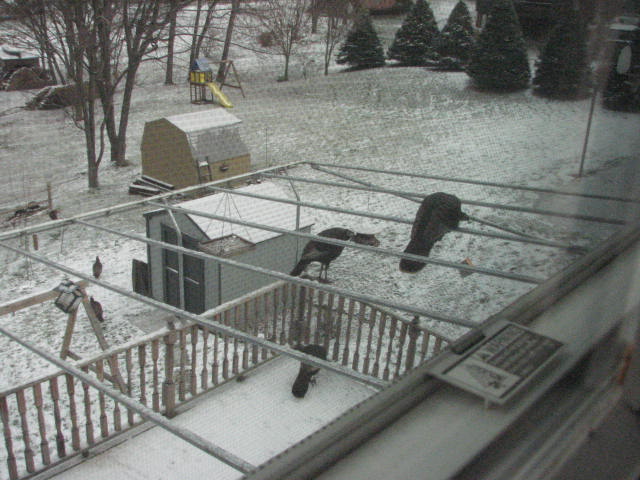
One of my interests is nature. I love when it comes into my yard in ways that are not frequent or usual.  Over the years our yard has seen many Wild Turkeys. Usually in small groups but today they broke our yard record.  I lost track at 40 while trying to count them.  I had a great vantage point to watch but not for photos. I will have to remove the window screen I guess.  One other time, years ago, we had 40 as well.  The last few days have seen the snow melting. You could almost see the excitement in the turkeys pecking around for whatever it is that they look for.  They moved on fast tho. I hope they come back again.  With this many turkeys around there will sure to be a few battles among the males as mating season starts.  

Today's photos


We have a few good turkey stories from years past.  So speaking of battles, a few years ago, we had a street fight. Two toms had their necks wrapped around each other and were oblivious to everything else in the street.  This went on for at least a half an hour.  It was actually quite comical looking at times but dead serious.  I do not know how it ended as the toms wrangled themselves into a yard where I could not see them anymore. Other than  a few scuffles, I had never witnessed this before and haven't since.  

When love is in the air, sometimes confusion can set in.  One spring, a tom decided that his reflection in the bumper of our truck was of interest.  He would look at himself and peck the bumpers.  It got so bad that he would get up on the truck cab roof as if to claim it as all his.  We had the scratch marks to show for it.  We were hesitant to go out and chase him because he could have chased us back.  Better to just watch and be entertained.


Turkeys like our bird feeders too.  Who me?


Please give credit and post a link to my blog if you intend to use any of the information written here. My blog posts are © Ann M Sinton 2022. All rights reserved. 


Monday, February 7, 2022

Week 6 - Maps (52 Ancestors in 52 Weeks)

 Maps are one of my favorite things.  I still have the very first map that we could call our own.  It was a Rand-McNally book atlas of all the states that I redeemed S & H Green stamps for.  We used this map for many years along with local maps that we purchased or picked up at gas stations and the AAA office.  We moved a bit in our early marriage and the first thing we needed in our new location was always a map.  In the car, my title became Navigator.  Later, when we started taking out of state vacations, they were always driving trips. Off to Barnes and Nobles for that state's map. We hardly ever got lost, well, at least in a car.  But that is another story.  

One of our trips was actually partially planned to visit the Cold Harbor Battlefield in Virginia so that I  could visit the site where my 3rd great grandfather, John Border Amos, fought with the 55th PA Infantry.  He was wounded there and that was the end of his time with the 55th.  When we were in the Visitor Center talking with the Park Ranger to find out where on the battlefield he may have been, she showed us some maps and told us how to find the spot.  You will breathe his air she said.   Yay!  We found the spot and I could not resist purchasing copies of the maps as well.  I am far from a Civil War expert, but I do like looking at these maps and seeing how detailed they were and being able to point to a spot and say he was right there.  


June 3 , 1864 - Battle of Cold Harbor - area circled is where John Border Amos was injured an attack


Now, I use our maps to find places that an ancestor lived and wish that I had known of that ancestor when I was in their neighborhood.  Today, I use Google maps to go places but it was way more fun to actually plan and map out our trips and sidetrips with the paper ones.  Or deviate from the plan if something more interesting came up.  I often wonder how our ancestors went west without a map, just following a worn trail or blazing their own.  Sounds intimidating.  But they managed and more places ended up on maps because of them.  Old historical maps are cool because the land, as in roads and streets or lack of,  and place names may have been different 100 years ago. 

Genealogy is kind of like a map too.  A map of your family that sometimes takes unexpected turns and ends at surprising destinations.    More often, the maps I refer to for genealogy are now online.  I can zoom in and see details a little better, but I miss the feel of the paper.  So I keep the paper ones.  

Happy traveling!


P.S. -  The morning after I wrote this, a map appeared in my Facebook feed from a historical group that I follow.  I immediately recognized it as a later map of the location where my husband's 4th great grandfather and his brother, Jacob & Joseph Sinton, owned a general store from the early 1800's to about 1847.  This map was from 1850.  I have some old news articles about the history of this store and went back to read them and one gave the name of the person who bought the property in 1847.  That name was on this 1850 map.  Bennett.  I always knew it was on this town square, but this gives a little more perspective than just knowing what is there today. Now I can pinpoint the exact location of the store and what was around it at the time.  


The Public Square of Wilkes Barre, PA in 1850 with "Bennett" in the right upper side of the square

Oct 26, 1945 The Wilkes Barre Times Leader Evening News


May 22, 1911 Wilkes Barre Record


As I said, I Love Maps!!

Please give credit and post a link to my blog if you intend to use any of the information written here. My blog posts are © Ann M Sinton 2022. All rights reserved. 


Saturday, January 29, 2022

Week 5: Branching Out (52 Ancestors in 52 Weeks)

 In week 2, I mentioned loving to find out how different people in my tree are related to seemingly unrelated other people in my tree.  An awkward way of describing this week's branching out theme.  It might be more like a tangled web or roots.  But to me, branching out is when I begin to investigate the families of an in law, a friend or a cousin's spouse or someone who has the same surname as one in my tree or even some famous individual or historical event.  And DNA matches, that I think is a whole other week's topic.  But the list goes on and on.   It seems the more I do this, the more connections I find.  It can be quite amazing to me how many connections there are.  Most of the time, I need to go way back to find them.  Sometimes it's just a marriage between this one's cousin and that one's cousin.    Other times we share a common ancestor.  My husband poo poos this as not related but I believe in the thought that we are all related.  We just don't know how unless we look. And therein lies my interest.  The fun is in the search and solving the HOW.  

The first unexpected connection that I uncovered was that my husband and I were 7th cousins thru shared ancestors named Robert(1616-1683)  & Sarah Allyn(1620-1683). Our 8th great grandparents, Robert and Sarah were both born in England and came over to America probably separately, Robert about 1637 to Salem, Massachusetts.  They married sometime between 1638 and 1641. My husband descends from two of their 5 children and I descend from 1 of their other children.  The family settled in New London county, Connecticut where both Robert and Sarah died.  

Happy Hunting!


Please give credit and post a link to my blog if you intend to use any of the information written here. My blog posts are © Ann M Sinton 2022. All rights reserved. 

Friday, January 28, 2022

The Butterfly Effect

I was going to save this topic for the summer, but an article that I read this morning prompted me to at least write about how I got started with this very interesting and gratifying activity.  One of my summer interests is raising Monarch butterflies.  June thru late September are spent tending to the Milkweed plants and looking for Monarch eggs and caterpillars on the milkweed.  

This all started innocently enough in 2005 when my husband and I stopped for a cone at the local ice cream stand one nice June evening.  Already being interested in nature, I spied a rather large and beautiful moth resting on the side of the trash can.  Our 2 oldest grandchildren were ages 4 and 2 at the time and I thought that they would really like to see this moth, so I took it home to keep just overnight to show them.  I placed the moth in one of those collapsible butterfly habitats that we already had.  I had bought one of the kits that let you raise Painted Lady Butterflies in 2003 for the grandkids to watch.

The Painted Lady


In the meantime, I, of course, went to the internet to identify this moth. It was a Polyphemus Moth, one of the largest moths in Pennsylvania.  I also found out that this moth does not eat like butterflies do, so I did not have to worry about feeding it.  The next morning I looked in on our overnight guest and was puzzled by a lot of small whitish dots spread all over the netting of the habitat.  Well guess what..... she, so it turns out, had laid eggs!  This was the moment when it all started.  I just could not ignore these eggs.  Back to the internet to see how long till they hatched and what they would eat.  Fortunately, one of the leaves that they eat was maple which I had plenty of in my yard.  About a week later, I had teeny tiny caterpillars to feed.  At first it was just a leaf or two, then a small branch, then I found myself practically giving my tree a good pruning! They were eating machines! My husband built me a larger screened box to protect the caterpillars from being eaten by birds. I had some rather large bright green caterpillars and then just like that they began wrapping themselves up in the leaves instead of eating them. This is where they would spend the next couple weeks.  So about a month and a half after finding that first moth, the new moths began emerging from their cocoons.  

The Polyphemus Moth

Very tiny eggs and caterpillars

Success!  Now just to release them and wish them luck!   Well guess what.... some of them were a little quicker than me and had already mated and left me more eggs!  Deja Vu, more leaves and more cocoons.  But this time I did not get any moths.  It turns out that depending upon what time of year they go into their cocoons, they may not come out until the following spring.  So they got a cozy sheltered spot on  my deck for the winter and I crossed my fingers.  

Spring arrived and the moths began emerging.  This time I was ready. As soon as their wings had dried and stiffened, I moved each one to the deck railing so they could leave as they wanted.  A few stayed around long enough to, guess what, mate. But this time they laid their eggs in a more natural spot somewhere in the maple tree I assume.  

This adventure was over, but I had already begun preparing to attract the Monarch butterflies to my yard.  I turned a small spot next to our shed into a garden, planted milkweed and waited.  


In August, about the time the I had finished raising the moths, I saw the first Monarch caterpillar on my milkweed.  I was very excited, but at this time I did not collect them and left them to nature.  One of these caterpillars had decided that the overhang of the shed roof was a good place to form his chrysalis.  I watched and waited and about 2 weeks later a gorgeous Monarch emerged.  Hooked again and I began collecting and feeding several more caterpillars that I found hoping to help the population along.  I had unknowingly become a citizen scientist. 


The first Monarch

At first I used the screened box  that had housed the moths the year before.  I was only raising a few the first few years and soon found out that my box did not keep the caterpillars in and the predators out very well.   So I invested in a larger mesh habitat.  It was perfect!  About this time I had learned how to spot the extremely tiny eggs.  This gave me many more monarchs to raise. 


Monarch eggs


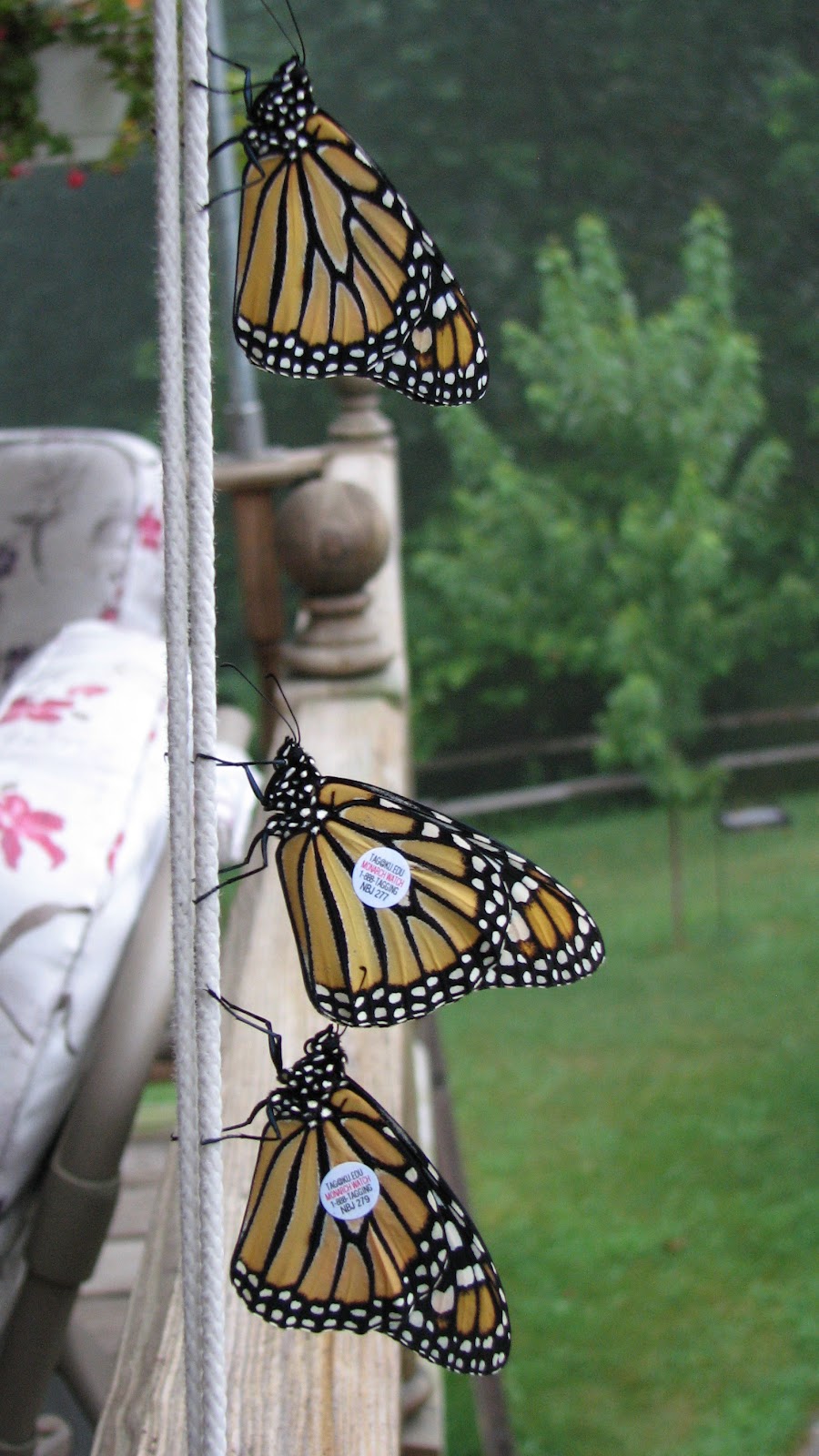
Monarch tags

 In 2010, I sent away for tiny tags that you apply to the wing before you release the butterfly.  This was a way to help scientists learn more about the Monarchs that were able to complete the annual migration to Mexico.  At this point, I was raising enough that I was able to give some to the grandkids so that they too could watch a butterfly emerged from it's chrysalis at home.  

For a few years, we were happily raising Monarchs each summer. Releasing as many as 50 a year.  I found that I was not growing enough Milkweed of my own and needed to take walks to places near me where I could collect milkweed leaves to feed the caterpillars. Fortunately, that would be enough. The road leading into our neighborhood has many plants growing along the roadside.  Then 2013 and 2014 came.  I had not one Monarch those years.  There had been a huge decline in the winter population of Monarchs making them scarce.  In 2015, things seemed to be back to normal with about 45 Monarchs released from my yard.  But again in 2016,  there were none.  The next 3 years were good for me. 

In 2018, I had learned about a disease that can spread among the Monarchs.  I learned how to test my Monarchs before releasing them.  This involves getting a few of the scales from the wing under a microscope to look for the disease spores. Although I never had any of my Monarchs test positive for this disease, I was still losing many more than I ever had before.  Apparently, my Milkweed patch had been found by a few of the predators that can parasitize a monarch egg or caterpillar which causes it to eventually die before becoming a butterfly.  

In 2019 I released 72!  A 60% success rate!  The most ever for me.  2020 was another disappointment because I had none once again.  In 2021, I only released 19, but better than none.  My daughter had also begun raising Monarchs at her home and eventually using them for her preschool classes as an educational tool. She has had really good years even when I did not until last year.  Even though she had quite a few, there were not nearly as many for her either.  

This brings me to the article that I read this morning saying that there is predicted to be another large decline in the Monarch population this year. So sad and disappointing.  I share a link to the article below.  

 https://dailynorthwestern.com/2022/01/25/city/the-monarch-butterfly-population-might-be-declining-heres-what-you-can-do/?fbclid=IwAR0Nhrn-DEsDst4rn9Nit7AhSR9e2dSV4drt2LDzoYIbW03QmtZMe_exgJc

I am not an extreme environmentalist but there are certain things, like the Monarchs, that I do care a bit more about.  I believe that some of the solutions can be very simple acts by us humans.  Such as not needing so much manicured lawn, mowing less and planting native plants that will be much better for us and nature.  If we all could just start with a little corner of our yards, I think we could start making a difference. We are part of the natural world as much as the Monarchs are. We all depend on each other. I hope that it is not too late for the Monarchs. 

Please give credit and post a link to my blog if you intend to use any of the information written here. My blog posts are © Ann M Sinton 2022. All rights reserved. 

Monday, January 24, 2022

Week 4: Curious (52 Ancestors in 52 Weeks)


Curiosity …. Where would we humans be without it.  It really is the foundation of everything. From figuring out how to do things to what's good to eat to "Don't touch that", we are full of questions.  Today, we go into space with thoughts of settling there someday, just as people settled America's West or the Pilgrims came to Plymouth 400 years ago.  But we are not only curious about where else we can go, but also about where we've been or more specifically, where we come from.  My story this week originates with my Dad.  As a child, I was aware of his frequent questioning whether  we were related to one of the Mayflower Pilgrims, Myles Standish and whether we were related to Pres. Richard Nixon.  I think that I can call this the foundation of my later interest in family history.  I came to find out that my Dad's family had a little bit of family history already due to his Aunt Helen's research and the names Julia (Standish) Martin and Sarah (Nixon) Heacock both appeared as my Dad's great grandmothers.  But IF & HOW might we be related to Myles Standish and Richard Nixon were the great questions.  


Julia Standish & her husband Merritt Martin in 1852  


Sarah Nixon Heacock  1835 - 1911


I lived with this information for quite awhile, but with our purchase of a computer in 1998, I was able to access an entire new world of information which led me to the answers of HOW.  It turned out that Julia was the 4th great granddaughter of Capt. Myles Standish of the Mayflower!  Before I shared this discovery, I checked and rechecked to be sure that I had it right.  I was satisfied, so I shared with my Dad.  I sent him a printout of all that I had found and he was happy to have it.   At this time, I had no interest in joining the Mayflower Society.  I was happy just to have proven the connection.  But as the 400th anniversary of the Mayflower Landing approached in 2020, I thought to myself that I would go ahead with the application for membership, feeling that it would be good to have it officially recognized for future family members who may have these same curiosities.  After a little additional work to meet the requirements of the society, as far as having possession of documents that prove each generation, I was approved for membership.  A nice feeling of accomplishment.

Myles Standish 1586 - 1656
my 8th great grandfather


Now the Nixon question required me to not only find as much out about my Nixon line as I could, but to also research Richard Nixon's line as well, hoping that they intersected at some point.  In week 1 of this challenge, I spoke a little about Zachariah Nixon of North Carolina.  He is Sarah Nixon Heacock's grandfather. This line of Nixons goes into very early North Carolina and is an English Quaker family.  Next on to Richard Nixon.  


In looking at Richard Nixon's family, I found that his Quaker Nixon roots came through Pennsylvania and Delaware, but they were originally from Ireland.  I was unable to find anything that could connect the two Nixon families.  BUT, while looking at his entire family, I started seeing a few familiar surnames.  One, on his mother's side, stood out.  Mendenhall.  I already knew that we had Quaker Mendenhall ancestors so it was just a matter of satisfying my curiosity as to whether his and mine were related.  Aaron Mendenhall who was born in 1690 in Pennsylvania was the connection.   He is my 7th great grandfather and Richard Nixon's 5th great grandfather.  So even though the Nixon connection was not there, we were still related to Richard Nixon.  My Dad was pleased.

Richard M Nixon 1913 - 1994
my 6th cousin 2 times removed

So actually, my dad's curiosity led to my proving his suspicions of two relationships. But my curiosity is a forever condition. As all family historians know, answering one question always leads to another question which curiosity cannot ignore.   


Happy searching!

Please give credit and post a link to my blog if you intend to use any of the information written here. My blog posts are © Ann M Sinton 2022. All rights reserved. 

I love connections!

 This week I discovered that two of my husband's new DNA matches have familial connections to both myself and Tom's  nephew-in-law. ...